


You may also like
-
Human Skeleton Poster
Institute of Liepzig · 1900 · Detailed human skeleton scientific print with crisp linework on warm beige paper
Poster from €9 · Framed from €16
Regular price From €6,00Regular price -
Anatomical plates Poster
Dr. Parker · 1850 · Detailed skeleton scientific print with crisp labels and a warm archival paper tone
Poster from €9 · Framed from €16
Regular price From €6,00Regular price -
Human Musculature Poster
Unknown artist · 1894 · Detailed human anatomy scientific print showing musculature studies on warm beige paper
Poster from €9 · Framed from €16
Regular price From €6,00Regular price -
Human Nervous System Poster
Galtier-Boissière and Émile · 1912 · Detailed anatomical scientific print of the human nervous system in red on white
Poster from €9 · Framed from €16
Regular price From €6,00Regular price


-

"Very nice Posters. The quality is amazing and we received it very quickly !"
-

"A shop to visit absolutely. Huge selection of posters. We spent more than an hour there !"
-

"Perfect to find gift. Price are very good. An they can frame and pack it on site"


About the Artist
Augé and Claude are credited with several early 20th-century educational illustration plates, contributing to the French tradition of scientific and anatomical imagery. Their work bridged the gap between art and instruction, providing accessible visual aids for schools and the broader public during a period when visual learning became central to education.
These illustrators operated at a time when France was investing in public health and education, making accurate anatomical visuals essential for both students and professionals. Their legacy endures in the clarity and reliability of their images, which remain valued for their educational and historical significance.
The Artwork
This anatomical plate reflects the era's drive to democratize scientific knowledge, as public education reforms and illustrated publishing brought complex subjects into everyday awareness. Around 1900, such reference images were widely used in classrooms and medical settings to explain the structure and function of the human body.
Rooted in the didactic traditions of French encyclopedias, this illustration was designed for quick consultation and repeated reference. Its enduring appeal places it alongside other science prints that blend informative content with visual refinement.
Style & Characteristics
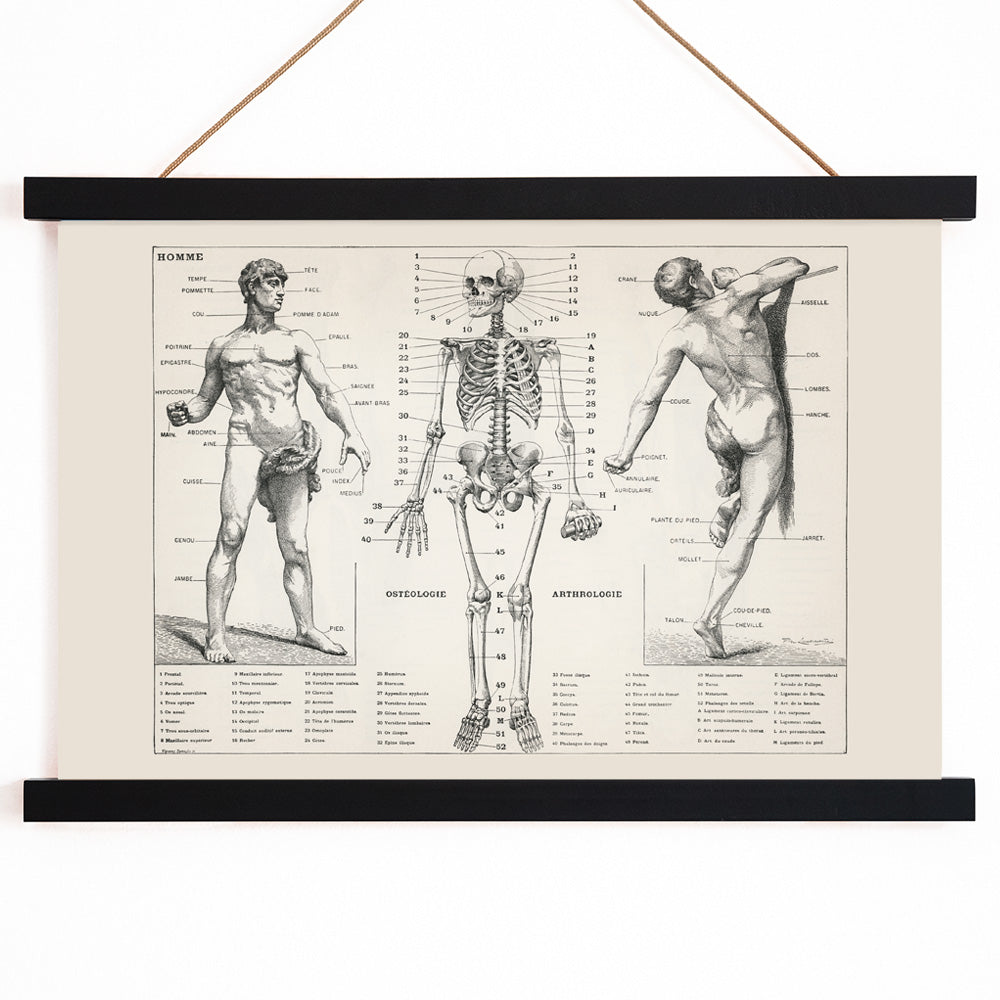
The composition centers on a detailed human figure, surrounded by smaller anatomical diagrams and precise labeling that organize the information clearly. Fine black lines and careful shading emphasize anatomical accuracy, while the restrained palette—primarily black ink on warm beige—gives the print an archival, timeless quality.
The mood is scholarly and composed, making it a natural fit for collectors of black and white prints and those who appreciate antique scientific illustration. The overall effect is both informative and aesthetically refined.
In Interior Design
This vintage anatomical scientific print lends a cultivated touch to home offices, libraries, studios, or medical spaces, offering historical depth without clinical sterility. Its neutral tones and elegant linework pair well with light woods, linen, and matte black accents, or can be harmonized with other beige wall art for a cohesive gallery wall.
It also complements maps, classic-art references, and typography, anchoring a thoughtful and intellectually engaging interior.