


You may also like
-
Filicinae–Laubfarne Poster
Ernst Haeckel · 1904 · Detailed fern botanical print balancing scientific precision with Art Nouveau grace
Poster from €9 · Framed from €16
Regular price From €6,00Regular price -
Siphonophorae Poster
Ernst Haeckel · 1866 · Intricate siphonophore scientific print with floating forms in crisp blues and reds
Poster from €9 · Framed from €16
Regular price From €6,00Regular price -
Actiniae Poster
Ernst Haeckel · 1904 · Detailed sea anemone scientific print with radiant tentacles arranged like jeweled marine flowers
Poster from €9 · Framed from €16
Regular price From €6,00Regular price -
Ascidiae Poster
Ernst Haeckel · 1904 · Intricate sea squirt scientific print arranged in a striking symmetrical natural history plate
Poster from €9 · Framed from €16
Regular price From €6,00Regular price


-

"Very nice Posters. The quality is amazing and we received it very quickly !"
-

"A shop to visit absolutely. Huge selection of posters. We spent more than an hour there !"
-

"Perfect to find gift. Price are very good. An they can frame and pack it on site"


About the Artist
Ernst Haeckel was a German biologist, philosopher, and illustrator whose pioneering work bridged the worlds of science and art in the late nineteenth and early twentieth centuries. Renowned for his ability to reveal the hidden structures of nature, Haeckel’s illustrations introduced the public to the intricate beauty of organisms often overlooked by the naked eye.
His landmark series Kunstformen der Natur played a significant role in popularizing natural history and inspired generations of artists and scientists alike. Haeckel’s approach combined scientific rigor with a refined aesthetic sense, making his plates enduring icons among collectors and admirers of natural history.
The Artwork
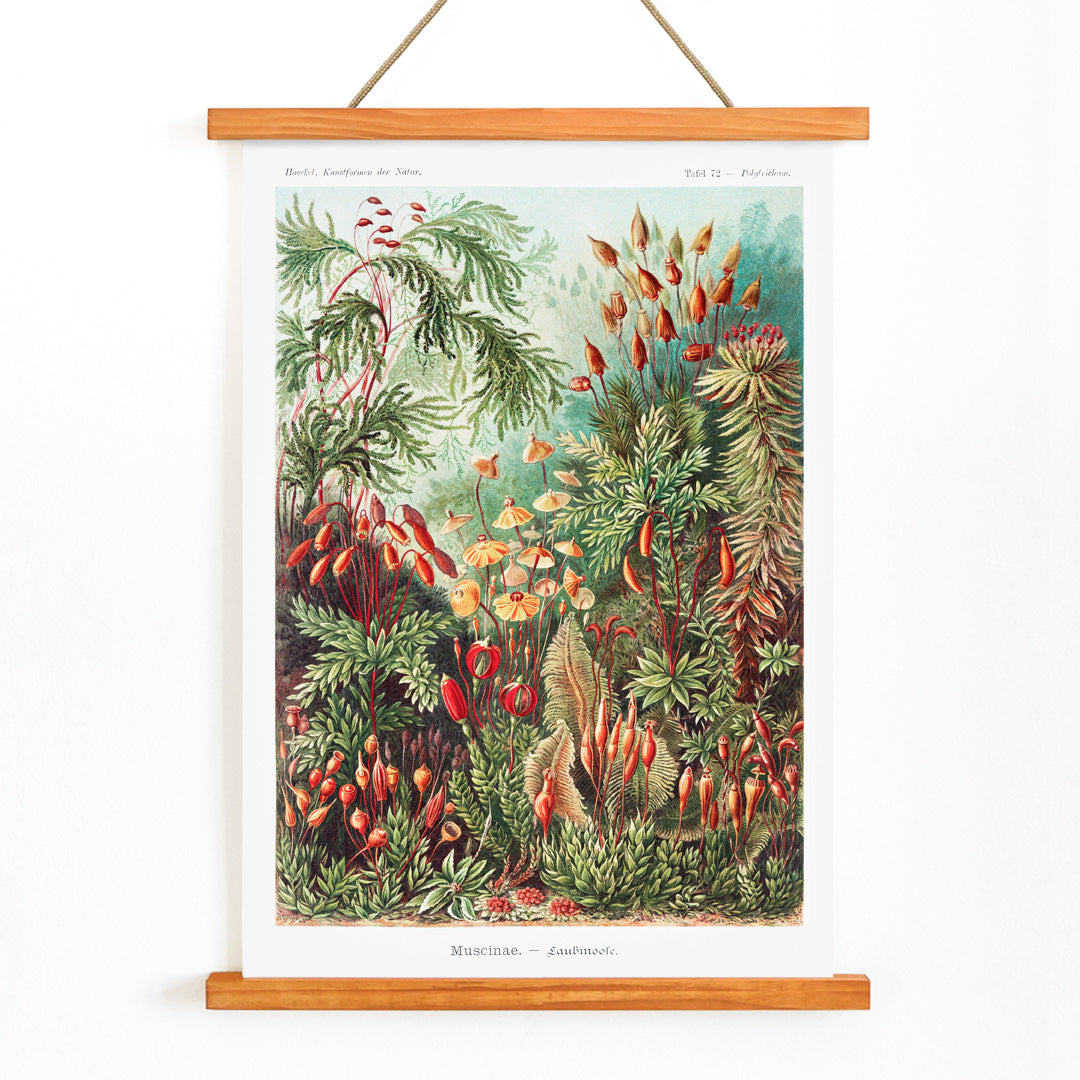
Muscinae–Laubmoose is part of Haeckel’s influential Kunstformen der Natur portfolio, created at a time when illustrated plates were crucial for scientific education and taxonomy. This work highlights the diversity of leafy mosses, presenting them as fascinating subjects worthy of close study rather than mere background elements.
Produced during an era captivated by evolutionary theory and classification, the illustration exemplifies how scientific imagery could foster curiosity and appreciation for the natural world. It stands as a testament to the period’s drive to document and understand life’s complexity, and it resonates with those who value both art and science. Explore related works in science wall art and botanical prints.
Style & Characteristics
The composition arranges various moss specimens in a symmetrical, plate-like format, each rendered with meticulous detail. Haeckel’s precise linework and subtle shading capture the textures of stems, leaves, and spore capsules, lending the print its analytical clarity.
The palette features natural greens and earthy browns, complemented by gentle botanical hues that evoke a calm, archival atmosphere. This scientific print balances decorative appeal with educational value, making it a harmonious addition to a collection of green tone wall art or vintage scientific plates.
In Interior Design
This vintage print brings a sense of quiet sophistication to spaces such as home offices, libraries, or serene bedrooms, where its intricate details invite contemplation. It pairs beautifully with Scandinavian, Japandi, and classic interiors, adding a touch of intellectual charm without overwhelming the decor.
For a cohesive look, echo the artwork’s greens with indoor plants or sage textiles, and choose natural wood frames like oak or walnut. It integrates seamlessly into nature-inspired gallery walls, especially when combined with other scientific or botanical art.