


You may also like
-
Delicate Soul Poster
Wassily Kandinsky · 1925 · Geometric abstract art print with crisp black lines, yellow highlights, and soft purple forms
Poster from €9 · Framed from €16
Regular price From €6,00Regular price -
Gewebe Poster
Wassily Kandinsky · 1923 · Geometric abstract art print featuring rhythmic blocks and lines on warm beige
Poster from €9 · Framed from €16
Regular price From €6,00Regular price -
Fröhlicher Aufstieg Poster
Wassily Kandinsky · 1923 · Dynamic geometric poster with rising diagonals, circles, and bold primary accents
Poster from €9 · Framed from €16
Regular price From €6,00Regular price -
11 tableux et 7 poèmes Poster
Wassily Kandinsky · 1945 · Rhythmic geometric poster balancing bright primary shapes with refined modernist typography
Poster from €9 · Framed from €16
Regular price From €6,00Regular price


-

"Very nice Posters. The quality is amazing and we received it very quickly !"
-

"A shop to visit absolutely. Huge selection of posters. We spent more than an hour there !"
-

"Perfect to find gift. Price are very good. An they can frame and pack it on site"


About the Artist
Gustavs Klucis was a Latvian-born artist who became a leading figure in Soviet Constructivism during the 1920s. Working in Moscow, he was instrumental in developing the visual language of political graphics, pioneering the use of photomontage, geometric abstraction, and experimental typography for mass communication. Klucis’s work reflects the era’s belief in art as a tool for education and social transformation, and his posters and exhibition designs remain icons of early twentieth-century design.
Closely associated with the spirit of VKhUTEMAS, the influential Moscow art and technical school often compared to the Bauhaus, Klucis’s creations embody the drive to merge art and industry. Today, his work stands as both a historical document and a touchstone for design-minded interiors.
The Artwork
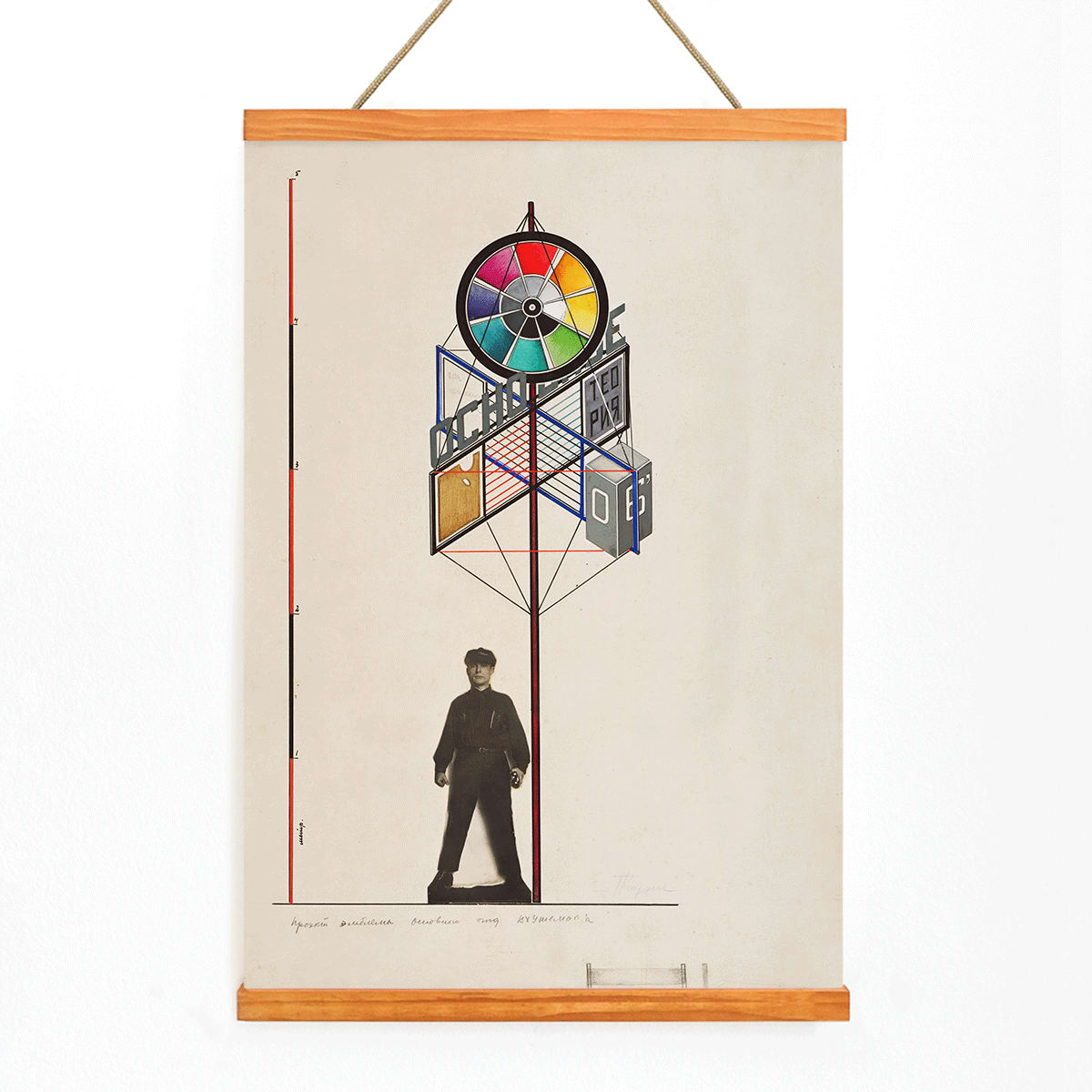
Osnovnoye Design emerged during a formative moment in Soviet visual culture, when exhibitions, posters, and printed materials were mobilized to communicate new social ideals. This piece is rooted in the pedagogical environment of VKhUTEMAS, where foundational design principles were taught as essential tools for shaping modern life. The artwork’s purpose was not mere decoration, but to instill discipline, clarity, and a sense of collective progress through visual order.
By channeling the energy of avant-garde classrooms and the public sphere, this poster illustrates how art became a means of organizing and inspiring society. It remains a significant example of Constructivist design, resonating with collectors and admirers of early modernism. For further exploration, see our abstract wall art and Bauhaus and Constructivist design collections.
Style & Characteristics
The composition is dominated by strong geometric forms, bold diagonals, and assertive Cyrillic typography arranged in a schematic fashion. The palette is anchored in black and white, with vivid red accents and touches of blue and green adding rhythm and emphasis. The overall effect is architectural and engineered, with crisp edges and flat shapes that convey a sense of urgency and structure.
This visual language aligns with the Constructivist tradition, emphasizing clarity and function over ornament. The poster’s dynamic layout and striking color contrasts make it a compelling choice for interiors that celebrate graphic modernism. It also pairs well with other red toned posters for a cohesive design scheme.
In Interior Design
This poster is well-suited for living rooms, hallways, or creative workspaces where its strong lines can provide a visual anchor. It complements industrial materials like concrete, light woods, chrome, or matte black, and can sharpen minimalist interiors without adding clutter. A thin black frame or simple white mat preserves the legibility of the typography from a distance.
For color coordination, echo the red accents in textiles or accessories while keeping the rest of the palette neutral for balance. Grouping it with other graphic works can create a unified gallery wall that highlights the Constructivist spirit.