


You may also like
-

Takai Poster
Teiji Takai · 1965 · Minimalist fish poster floating on ultramarine blue with crisp hand-drawn lines
Poster from €9 · Framed from €16
-

Maison de la Pensée française poster Poster
Henri Matisse · 1950 · Exhibition poster with a masklike face and blue lettering
Poster from €9 · Framed from €16
-

Woman and Bird at Night Poster
Joan Miro · 1947 · Playful surrealist poster with midnight blue field and bright red and yellow signs
Poster from €9 · Framed from €16
-

Dance at the Japan Youth Hall Poster
Unknown artist · 1934 · Japanese folk dance poster featuring a kimono-clad dancer lifting a fan against blue
Poster from €9 · Framed from €16


-

"Very nice Posters. The quality is amazing and we received it very quickly !"
-

"A shop to visit absolutely. Huge selection of posters. We spent more than an hour there !"
-

"Perfect to find gift. Price are very good. An they can frame and pack it on site"


About the Artist
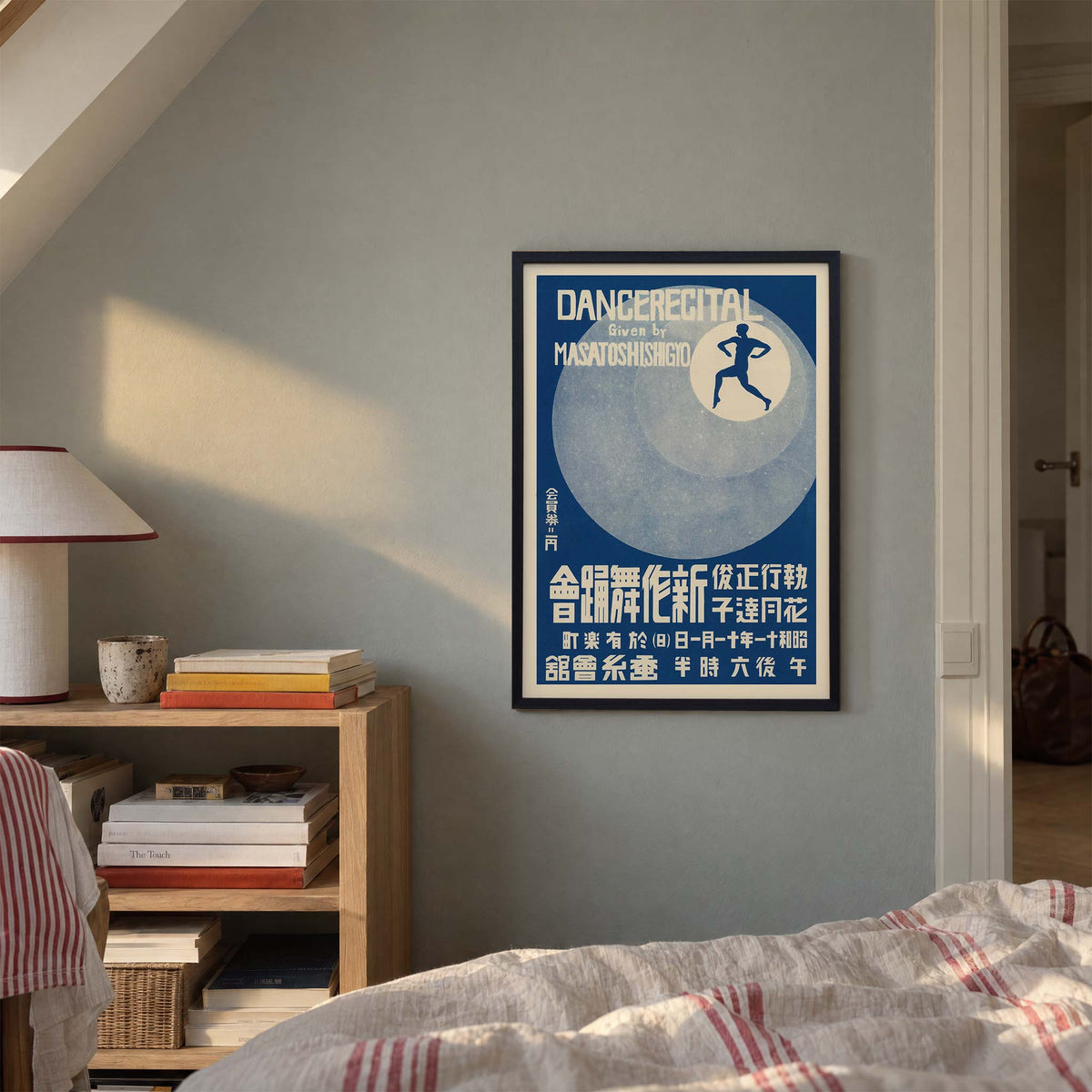
By an unknown artist, this 1936 poster puts Masatoshi Shigyo at the centre of a Japanese dance announcement that also addresses readers in English. The title Dance Recital Given by Masatoshi Shigyo identifies a specific performer rather than a theatre company or commercial product. That personal billing gives this Japanese dance recital poster its historical intimacy: a name once associated with an evening onstage now reaches us across nine decades. Although the designer remains unidentified, the connection between geometric modernism and performance publicity offers a starting point for understanding the purpose of this vintage print.
The Artwork
Before the curtain rose, an audience had to be invited. This vintage poster served that practical purpose, announcing a dance recital by Masatoshi Shigyo in 1936. A recital asks spectators to follow a performer through movement unfolding in real time; its advertising must make that fleeting experience seem worth seeking out. Here, the promise is an encounter with a named dancer, not an anonymous spectacle. Viewed today as an art print, the announcement preserves something a performance cannot: the invitation itself, held at the moment when the evening was still ahead and anticipation did the work.
Style & Characteristics
A blue dancer stretches across a cream circle near the upper right, one knee raised and the other leg reaching diagonally downward. Larger pale circles spread behind the figure, their mottled surfaces softening the deep blue ground. The eye travels from the suspended pose to the English title across the top, then drops to the densely packed Japanese lettering below. Cream strokes crowd together near the foot of this vertical poster, while the circular forms leave more breathing room overhead. The contrast between the small silhouette and those broad discs gives this 1930s dance poster its sense of scale.
In Interior Design
Imagine a reading corner in late afternoon, where this Japanese dance wall art hangs above a low oak chair and daylight grazes the paper. A slim dark frame echoes the blue silhouette, while a cream cushion brings the lighter lettering into the home decor without recreating a 1930s setting. From the chair, the airborne figure invites closer inspection; across the room, the largest circle remains legible as a pale disc against blue. For interior decoration centred on this fine art print, leave the surrounding wall bare so the Japanese lettering remains visible without competing pictures nearby.