


You may also like
-
The human body Poster
Augé and Claude · 1900 · Antique anatomical scientific print presenting the human figure with labeled study diagrams
Poster from €9 · Framed from €16
Regular price From €6,00Regular price -
Human Skeleton Poster
Institute of Liepzig · 1900 · Detailed human skeleton scientific print with crisp linework on warm beige paper
Poster from €9 · Framed from €16
Regular price From €6,00Regular price -
Equine muscular system Poster
Unknown artist · 1904 · Detailed equine anatomy scientific print showing superficial muscles in red with crisp numbered labels
Poster from €9 · Framed from €16
Regular price From €6,00Regular price -
Anatomical plates Poster
Dr. Parker · 1850 · Detailed skeleton scientific print with crisp labels and a warm archival paper tone
Poster from €9 · Framed from €16
Regular price From €6,00Regular price


-

"Very nice Posters. The quality is amazing and we received it very quickly !"
-

"A shop to visit absolutely. Huge selection of posters. We spent more than an hour there !"
-

"Perfect to find gift. Price are very good. An they can frame and pack it on site"


About the Artist
George Stubbs was an English painter and draughtsman renowned for his pioneering studies of horses. Active during the eighteenth century, Stubbs combined artistic skill with scientific inquiry, producing works that appealed to both art connoisseurs and scholars. His dedication to anatomical accuracy influenced generations of artists and veterinarians, and his illustrations remained in circulation through numerous later editions.
Stubbs’s legacy endures as his equine studies continue to be admired by collectors interested in famous artists and those drawn to the intersection of art and science.
The Artwork
The Anatomy of the Horse reflects the Enlightenment era’s fascination with understanding the natural world through observation and study. Stubbs created this series to provide a comprehensive visual guide for artists, scientists, and students, bridging the gap between creative and scientific disciplines.
This 1853 edition demonstrates the lasting value of his work in the nineteenth century, when interest in veterinary science and equestrian culture was growing. The print stands as a testament to the enduring appeal of anatomical illustration, making it a natural companion to other science themed art and historical wall decor.
Style & Characteristics
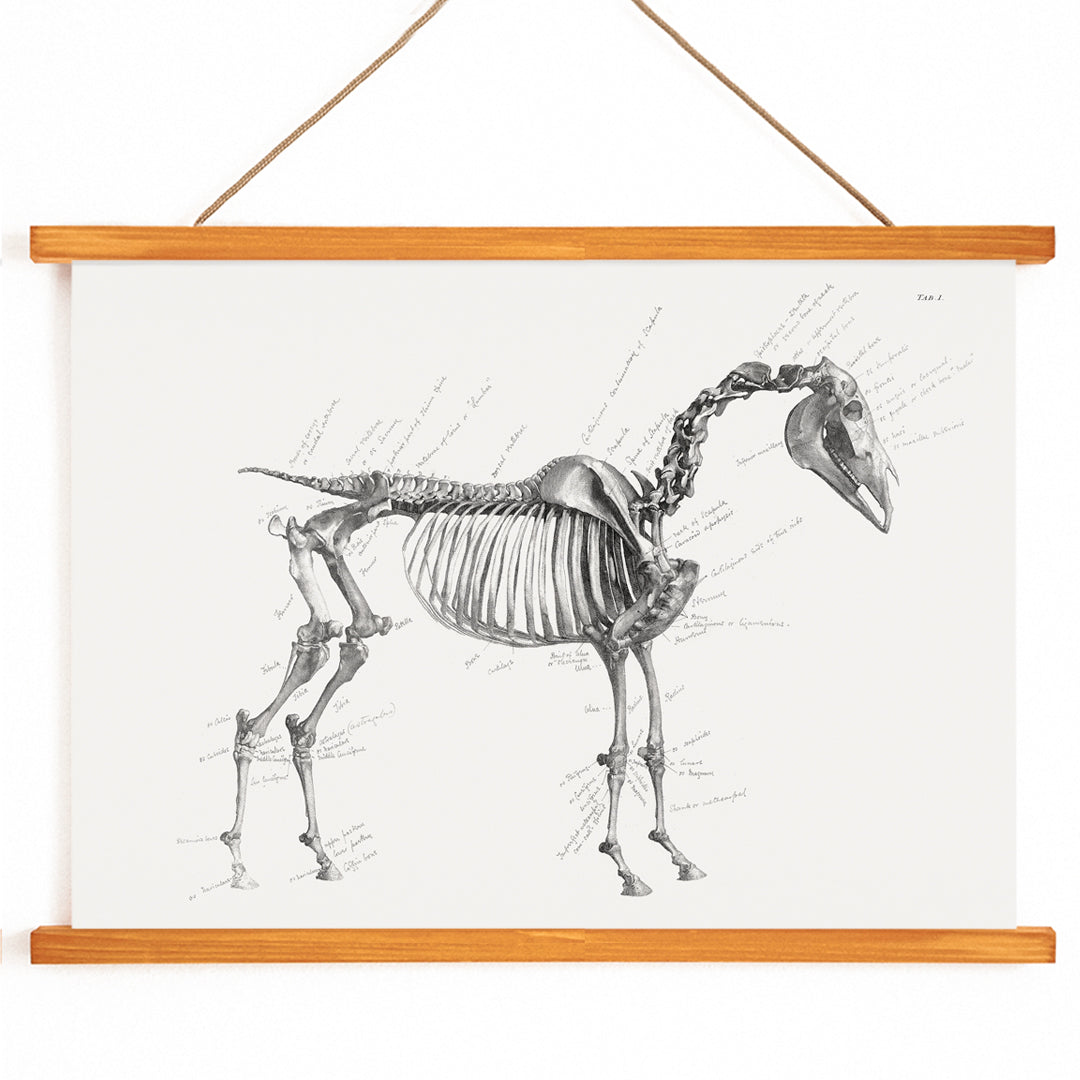
This disciplined scientific plate features a horse in profile, meticulously rendered with precise black linework and detailed anatomical labeling. The composition is clear and orderly, designed for study rather than embellishment, with restrained shading that emphasizes structure and form.
The monochrome palette imparts a calm, scholarly atmosphere, ideal for a refined gallery wall. The print’s technical precision and balanced layout make it a compelling choice for black and white poster collections and for those who appreciate classic equine anatomy art.
In Interior Design
This artwork is well suited to spaces that value intellect and tranquility, such as offices, libraries, studios, or sophisticated living rooms. It pairs beautifully with leather, dark wood, and warm neutral tones, adding a thoughtful accent without overwhelming the space.
For contemporary interiors, combine it with minimalist furnishings and matte black details to highlight the crisp linework. It also complements equestrian and heritage-inspired rooms, and gains a polished, archival look when framed with selections from frames.