




-

"Very nice Posters. The quality is amazing and we received it very quickly !"
-

"A shop to visit absolutely. Huge selection of posters. We spent more than an hour there !"
-

"Perfect to find gift. Price are very good. An they can frame and pack it on site"


About the Artist
For Franz Kraus, the journey to Tel Aviv preceded this invitation to visit Palestine. Born in Austria in 1905, he developed his commercial graphic practice in Berlin before leaving Germany in 1933 and settling in Tel Aviv the following year. His experience in European advertising informed a direct visual language suited to public display. Rather than addressing gallery audiences, Kraus made an image intended to persuade prospective travellers. This Franz Kraus vintage poster therefore records how an immigrant designer interpreted a tourism commission for an international public through modern graphic art.
The Artwork
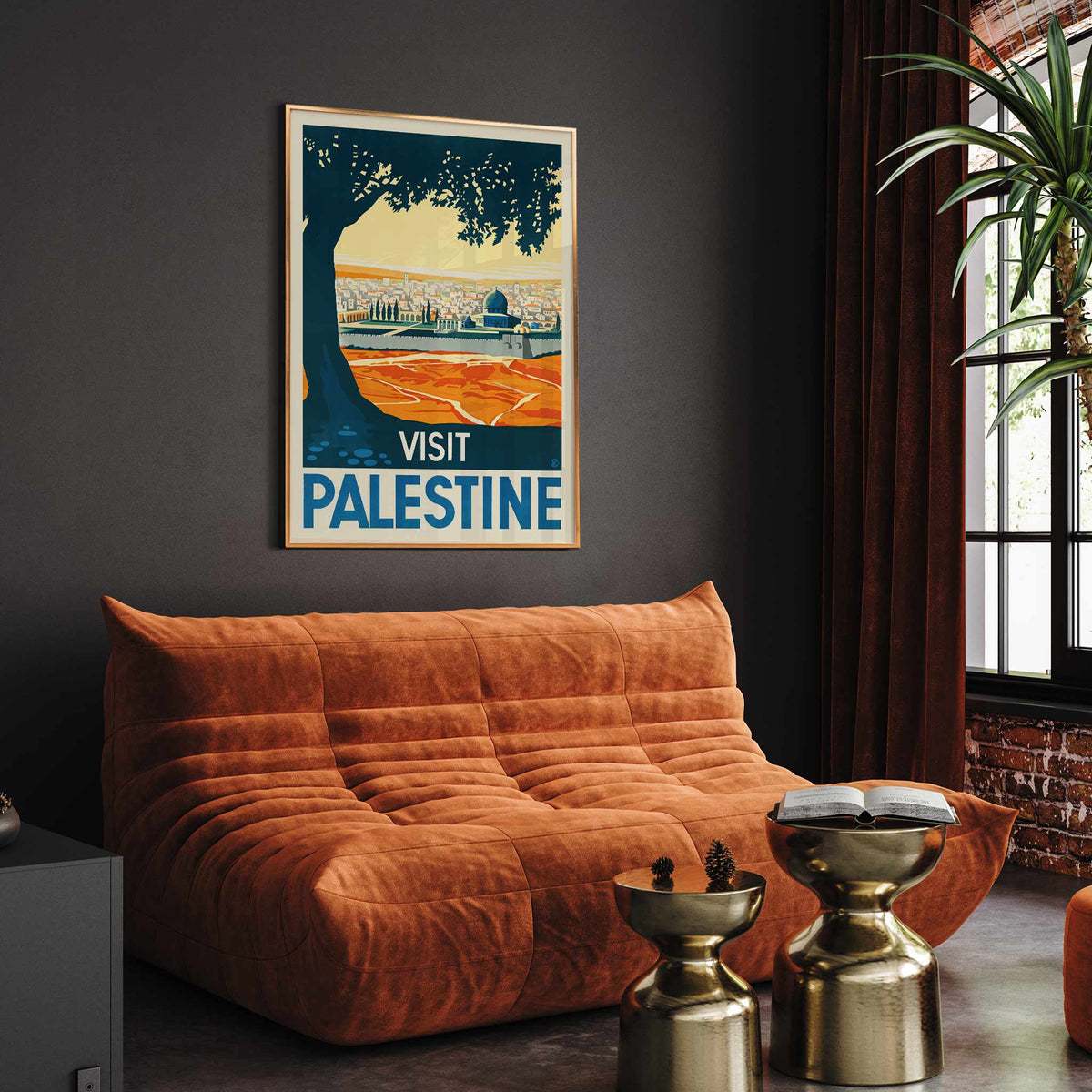
The invitation addressed travellers in 1936, during the British Mandate period in Palestine. Commissioned by the Tourist Development Association of Palestine, Visit Palestine promoted Jerusalem through a place already carrying religious and historical significance far beyond the region. The Dome of the Rock identifies the promised destination without turning the image into a simple souvenir. Its purpose was practical: to encourage travel by making the city appear both storied and accessible. Viewed as a vintage print today, the 1936 travel advertising poster preserves how a tourism campaign framed Jerusalem for prospective visitors and turned historical travel into a persuasive public message.
Style & Characteristics
Deep blue shade opens onto a yellow sky and a densely rendered Jerusalem skyline. A monumental tree occupies the left edge, while its canopy arches overhead and breaks the light into irregular fragments. Across the middle distance, pale buildings gather behind the walls, with the blue Dome of the Rock rising above them. Orange terrain sweeps through the foreground in angular bands crossed by cream paths. Below the image, VISIT appears in white on blue, then PALESTINE fills a cream panel in tall blue Art Deco capitals. The limited palette separates the shaded tree from the heated land and distant city.
In Interior Design
In a reading room, this vertical poster can hang above a low walnut bookcase, where late afternoon light echoes the yellow horizon. A linen armchair facing the fine art print invites close viewing of the small rooftops between pages. The orange terrain warms a shaded wall, while the deep blue tree connects the image to dark wood below. Here, historical wall art shapes the interior decoration through the force of its original advertising purpose. A nearby architectural sketch lets the bold lettering structure the home decor and keeps the Jerusalem panorama as the focus.