




-

"Very nice Posters. The quality is amazing and we received it very quickly !"
-

"A shop to visit absolutely. Huge selection of posters. We spent more than an hour there !"
-

"Perfect to find gift. Price are very good. An they can frame and pack it on site"


About the Artist
Lucien Rudaux gives this 1923 planetary chart a clear place within his life as a French astronomer and artist. His work joined astronomical knowledge with the imaginative reach of early space art, helping readers picture worlds that could not yet be photographed by spacecraft. Rudaux also established an observatory at Donville in Normandy, where sustained observation informed his sense of celestial order. That background matters here: the poster is not fantasy dressed as science, but a considered explanation of the solar system. For anyone choosing a Lucien Rudaux fine art print, it offers a direct encounter with the artist behind this vintage poster.
The Artwork
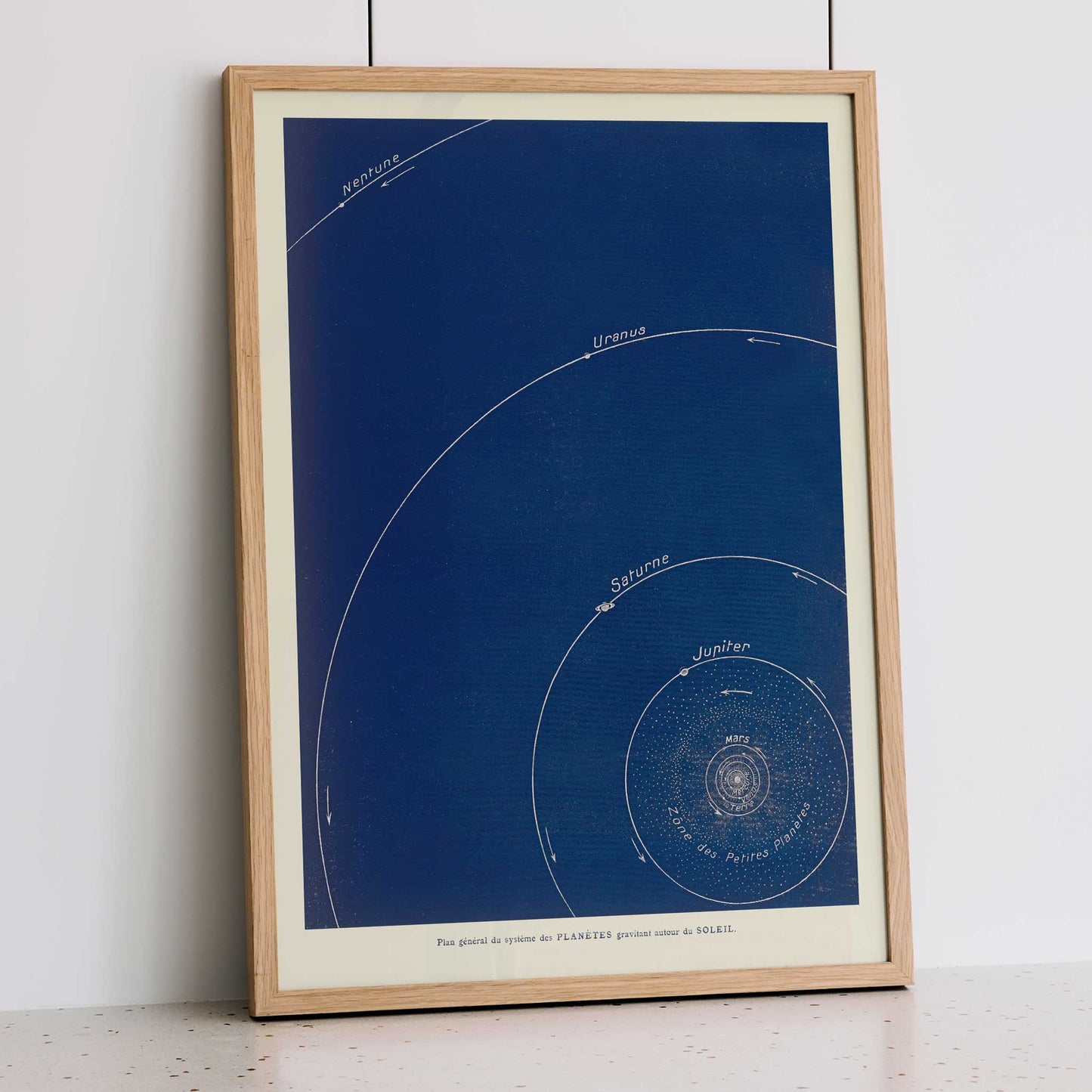
The title General plan of the planetary system states the purpose without turning the subject into myth. Dated 1923, the chart belongs to a period when astronomy reached homes through printed teaching aids rather than digital simulation. Its role was practical: to help a reader understand the relationship between the Sun and the planets as one system, making immense distances available to patient study. That educational aim gives the piece historical charge. It records how pre-space-age knowledge travelled through paper, allowing a reader to follow an idea that could not be tested in person. As a vintage print, it preserves the public face of astronomy.
Style & Characteristics
Deep blue fills the field, giving the orbital lines room to travel. A fine white arc enters from the upper left beside Neptune, while a much larger curve sweeps across the upper half beside Uranus. Lower down, Saturn and Jupiter sit on tighter paths around the Sun, which is placed near the bottom right. Small pale marks gather around the inner orbits, where the label for the minor planets can be read. The eye moves from the remote outer paths toward the compact centre, then returns to the broad empty blue. This vertical poster turns astronomical measurement into quiet scientific wall art.
In Interior Design
In a study with a walnut desk, place this vertical poster above a shelf of astronomy books. The blue field would deepen against warm plaster, while its white orbital lines could echo the narrow geometry of a brass reading lamp. From the desk chair, the subject would support a pause between reading and work, because the eye can travel across the chart without exhausting its quiet sense of scale. A black frame would give the pale border a firm edge and keep the scientific subject legible at a distance. As home decor, this art print brings interior decoration toward curiosity rather than ornament alone.