


You may also like
-
Economical use of plants Poster
Marcius Willson · 1865 · Detailed botanical chart poster mapping practical plant uses in crisp labeled vignettes
Poster from €9 · Framed from €16
Regular price From €6,00Regular price -
Forms of leaves Poster
Marcius Willson · 1890 · Educational leaf anatomy print with labeled forms and gentle green botanical tones
Poster from €9 · Framed from €16
Regular price From €6,00Regular price -
Collection of leaves Poster
Shirley Hibberd · 1855 · Delicate botanical print presenting varied leaf forms with fine veins on warm ivory paper
Poster from €9 · Framed from €16
Regular price From €6,00Regular price -
Familiar colors Poster
Marcius Willson · 1890 · Educational color chart poster featuring geometric squares and triangles in vivid primary colors
Poster from €9 · Framed from €16
Regular price From €6,00Regular price


-

"Very nice Posters. The quality is amazing and we received it very quickly !"
-

"A shop to visit absolutely. Huge selection of posters. We spent more than an hour there !"
-

"Perfect to find gift. Price are very good. An they can frame and pack it on site"


About the Artist
Norman A. Calkins was an influential American educator in the late 19th century, renowned for his advocacy of object teaching—a method that emphasized learning through tangible examples. His educational materials, especially visual aids, helped shape the way science and practical knowledge were introduced in classrooms across the United States.
Calkins believed that connecting academic subjects to everyday life would make learning more meaningful for students. His charts and posters, such as this one, reflect a commitment to making complex subjects accessible and relevant, encouraging curiosity about the natural world and its role in daily living.
The Artwork
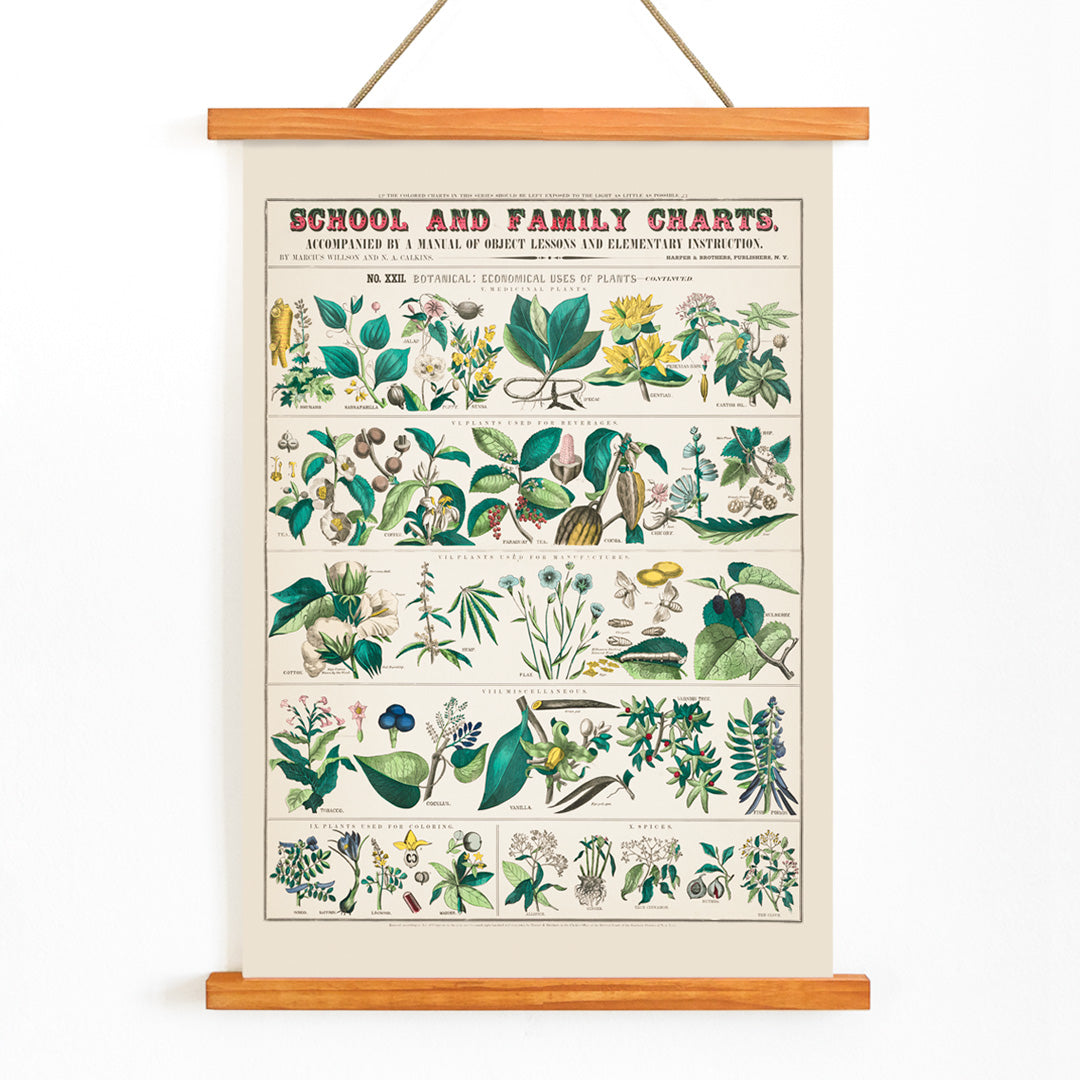
Economical Uses of Plants was created during a time when science education was gaining prominence in schools, mirroring broader societal changes in agriculture and industry. This chart was intended to teach students how plants underpin not just nature, but the economy and household life, illustrating the practical value of botanical knowledge.
Serving as a bridge between natural history and commerce, the chart organizes plant-derived products into clear, labeled categories. It was designed for classroom walls, where it could spark discussion about the interconnectedness of environment, labor, and everyday goods. For more on this intersection of science and daily life, see our science wall art collection.
Style & Characteristics
The artwork features a structured grid layout, with a bold title at the top and numerous small illustrations, each accompanied by a precise label. The fine black linework gives the images clarity and a sense of order, reminiscent of classic textbook diagrams.
Delicate hand-colored touches in green, yellow, blue, and red bring the illustrations to life against a warm, paper-toned background. The overall mood is scholarly yet inviting, making it a favorite among collectors of botanical prints and those who appreciate antique educational graphics.
In Interior Design
This vintage botanical print is well-suited to kitchens, studies, or gallery walls where learning and conversation are valued. Its organized composition complements both traditional and modern interiors, adding a thoughtful focal point to any room.
Pair it with natural materials and colors—such as leafy greens, muted blues, or light wood tones—for a harmonious look. A simple mat and classic frame will highlight its historical charm; explore our frames for suitable options.