


You may also like
-

Political collage Poster
Karl Wiener · 1938 · Tense newspaper collage poster layering headlines and bold symbols from prewar Europe
Poster from €9 · Framed from €16
-

Gegenwart Poster
Karl Wiener · 1923 · Modernist abstract poster featuring a black grid against a glowing sunlit field
Poster from €9 · Framed from €16
-

Leere Poster
Karl Wiener · 1921 · Minimalist blue gradient art print that turns empty space into quiet visual depth
Poster from €9 · Framed from €16
-

Girl and Death Poster
Karl Wiener · 1941 · Surreal memento mori poster featuring a young woman with skeletal silhouette in blue-black tones
Poster from €9 · Framed from €16


-

"Very nice Posters. The quality is amazing and we received it very quickly !"
-

"A shop to visit absolutely. Huge selection of posters. We spent more than an hour there !"
-

"Perfect to find gift. Price are very good. An they can frame and pack it on site"


About the Artist
Karl Wiener was a Viennese artist active during the interwar period, recognized for his disciplined draughtsmanship and innovative approach to portraiture. Working at a time when Expressionism and New Objectivity were reshaping European art, Wiener explored the psychological depth and structure of the human face, moving beyond mere likeness to evoke presence and introspection.
His work reflects the intellectual and cultural ferment of early twentieth-century Vienna, a city redefining itself after the First World War. Wiener’s portraits are valued for their clarity and tension, offering a window into the evolving ideas of identity and modernity that characterized the era.
The Artwork
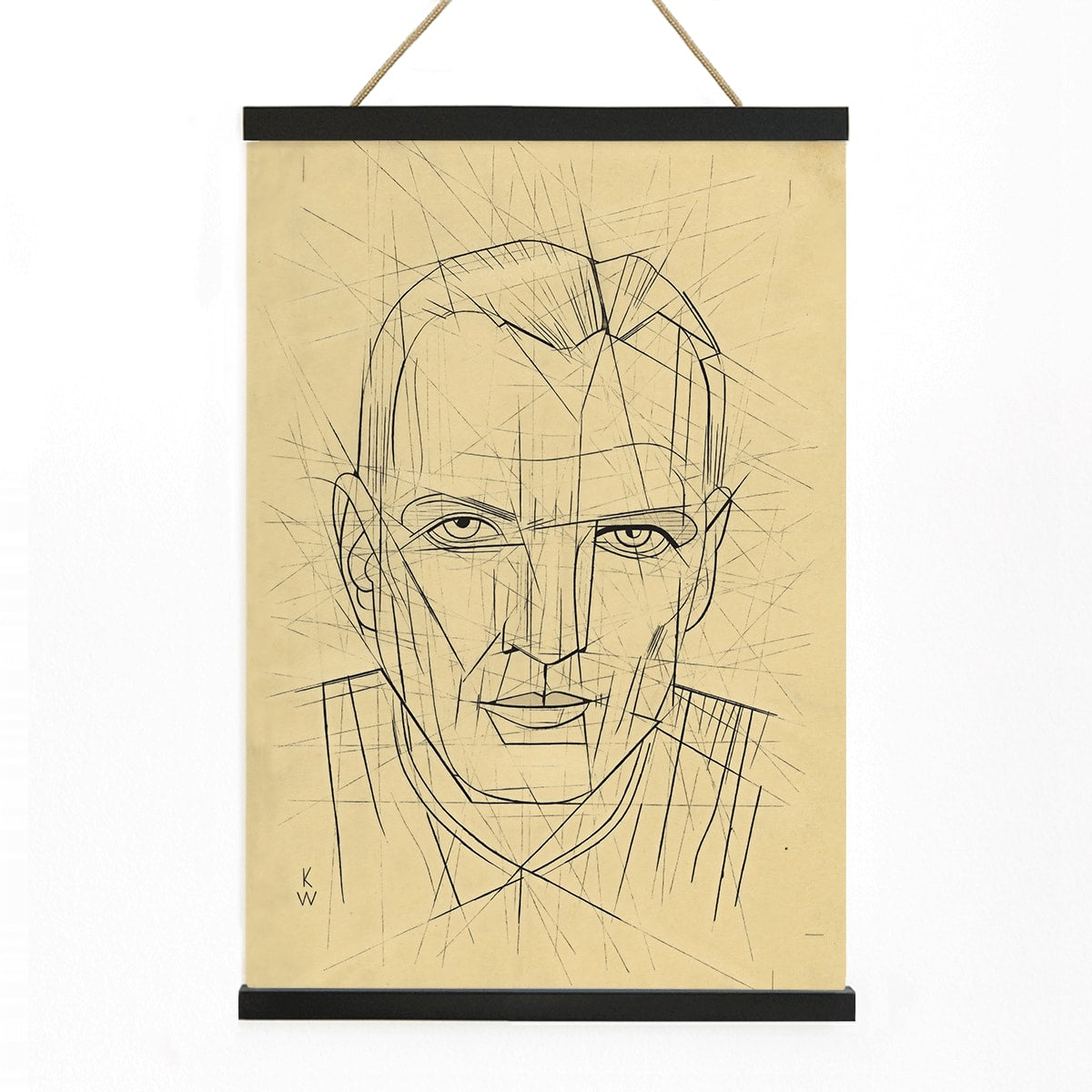
Created in 1923, this portrait emerged during a period when artists in Vienna were seeking new ways to represent the individual amidst social and cultural change. Rather than depicting elaborate narratives, Wiener focused on the direct encounter between viewer and sitter, using portraiture to explore themes of selfhood and emotional honesty.
This work exemplifies the modernist desire for reduction and authenticity, emphasizing the sitter’s presence through structure and expression. It stands as a testament to the era’s search for new visual languages to capture the complexities of the human experience.
Style & Characteristics
The portrait is rendered as a stylized sketch, defined by angular contours and simplified facial planes. Strong black linework shapes the head and features, set against a calm beige background that allows negative space to play a significant role in the composition.
The palette is restrained, limited to black on beige, lending the image a quiet severity and refined, archival quality. Its graphic directness will appeal to admirers of black and white wall art and the geometric clarity found in the Bauhaus collection.
In Interior Design
This art print brings an understated sophistication to living rooms, hallways, or offices, serving as an intelligent focal point. The neutral tones pair well with oak, walnut, brushed steel, and textured linens, making it easy to integrate into contemporary interiors.
Consider displaying it within a monochrome gallery wall or allowing it to stand alone above a console for a contemplative effect. A slim black frame highlights the crisp lines, and exploring frames can help you find the perfect finish for your decor style.