


You may also like
-

Great gateway of Thebes Poster
David Roberts · 1846 · Atmospheric vintage print of Karnak gateway with intricate hieroglyphs and small figures
Poster from €9 · Framed from €16
-

Physical map of the World Poster
James Reynolds · 1850 · Detailed world physical map vintage print with shaded relief and crisp place names
Poster from €9 · Framed from €16
-

Paris Ses Monuments Poster
Borremans, F · 1924 · Illustrated Paris monuments poster featuring a central city map and landmark scenes
Poster from €9 · Framed from €16
-

Eastern division of Paris Poster
James Shury · 1834 · Finely engraved Paris map poster with dense street detail and crisp black linework
Poster from €9 · Framed from €16


-

"Very nice Posters. The quality is amazing and we received it very quickly !"
-

"A shop to visit absolutely. Huge selection of posters. We spent more than an hour there !"
-

"Perfect to find gift. Price are very good. An they can frame and pack it on site"


About the Artist
Émile Prisse d'Avennes was a French Egyptologist, draftsman, and pioneering documentarian of monuments along the Nile. In the 19th century, he played a vital role in recording and sharing Egypt's ancient heritage with European audiences through detailed drawings, plates, and maps. His work bridged the gap between field archaeology and the scholarly publishing world of his time, shaping how ancient Egypt was visualized and studied in the West.
Prisse d'Avennes combined rigorous observation with artistic precision, ensuring his maps and illustrations would serve both as scientific records and as lasting works of art for future generations.
The Artwork
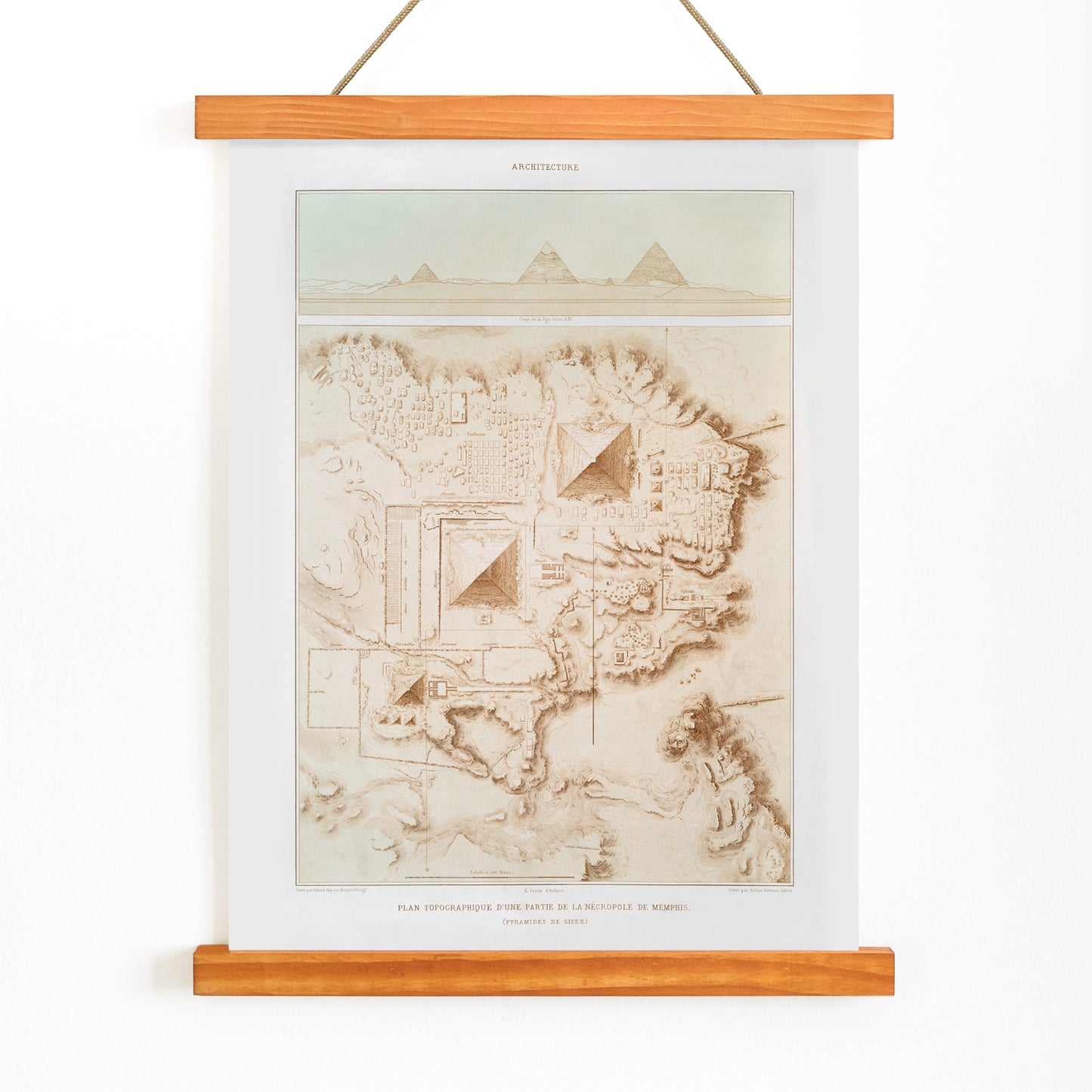
This 1878 topographic map centers on the Memphite Necropolis, the extensive funerary landscape associated with ancient Memphis and its royal cemeteries. Created during a period when archaeology was becoming increasingly systematic, the map functioned as a practical tool for researchers and explorers, aiding in the study and orientation of Egypt's pyramid fields.
Beyond its utilitarian purpose, the map reflects a 19th-century fascination with documenting and understanding the ancient world through precise measurement and cartography. It stands as a testament to the era's spirit of exploration and the desire to make the mysteries of antiquity accessible and comprehensible.
Style & Characteristics
The map is composed with the clarity of a surveyor's chart, featuring dense labeling, orderly symbols, and a structured layout that guides the viewer across the depicted terrain. Fine linework and meticulous markings create a sense of calm analysis, inviting close inspection and appreciation of detail.
Set against a pale, paper-like background in white and beige tones, the overall effect is quiet and archival. This vintage print is well suited for those interested in historical maps, scientific illustration prints, or understated, scholarly decor.
In Interior Design
This vintage map print is ideal for studies, offices, or living spaces where a touch of intellectual curiosity is desired. Its neutral palette pairs harmoniously with natural materials such as limestone, oak, and linen, making it a versatile choice for minimalist, modern, or classic interiors.
The warm undertones blend well with beige toned posters and textured walls, complementing both monochrome and earthy color schemes. It appeals to design enthusiasts, lovers of Egyptian history, and anyone seeking refined, research-inspired wall art.