


You may also like
-
Poissons Poster
Claude Augé · 1908 · Detailed fish scientific print arranged as an educational chart on clean white ground
Poster from €9 · Framed from €16
Regular price From €6,00Regular price -
Plantes Potageres Poster
Claude Augé · 1908 · Educational vegetable print with labeled garden plants in crisp botanical detail
Poster from €9 · Framed from €16
Regular price From €6,00Regular price -
Voilier Poster
Claude Augé · 1908 · Labeled sailboat diagram print with crisp linework and elegant French annotations
Poster from €9 · Framed from €16
Regular price From €6,00Regular price -
Peinture et Teinture Poster
Claude Augé · 1908 · Educational color chart poster pairing French labels with orderly pigment swatches
Poster from €9 · Framed from €16
Regular price From €6,00Regular price


-

"Very nice Posters. The quality is amazing and we received it very quickly !"
-

"A shop to visit absolutely. Huge selection of posters. We spent more than an hour there !"
-

"Perfect to find gift. Price are very good. An they can frame and pack it on site"


About the Artist
Claude Augé was a French lexicographer and editor, renowned for his pivotal role at Larousse during the early 20th century. Rather than creating art in the traditional sense, Augé contributed to the visual culture of the Belle Époque by overseeing the production of educational reference works. His leadership helped transform encyclopedic illustration into a vital part of everyday learning, making knowledge accessible and visually engaging for a broad audience.
Through his editorial direction, Augé’s era at Larousse produced reference plates that bridged the worlds of scholarship and visual communication. These works reflect the period’s commitment to clarity and the democratization of information, offering collectors a glimpse into the intellectual spirit of early modern France.
The Artwork
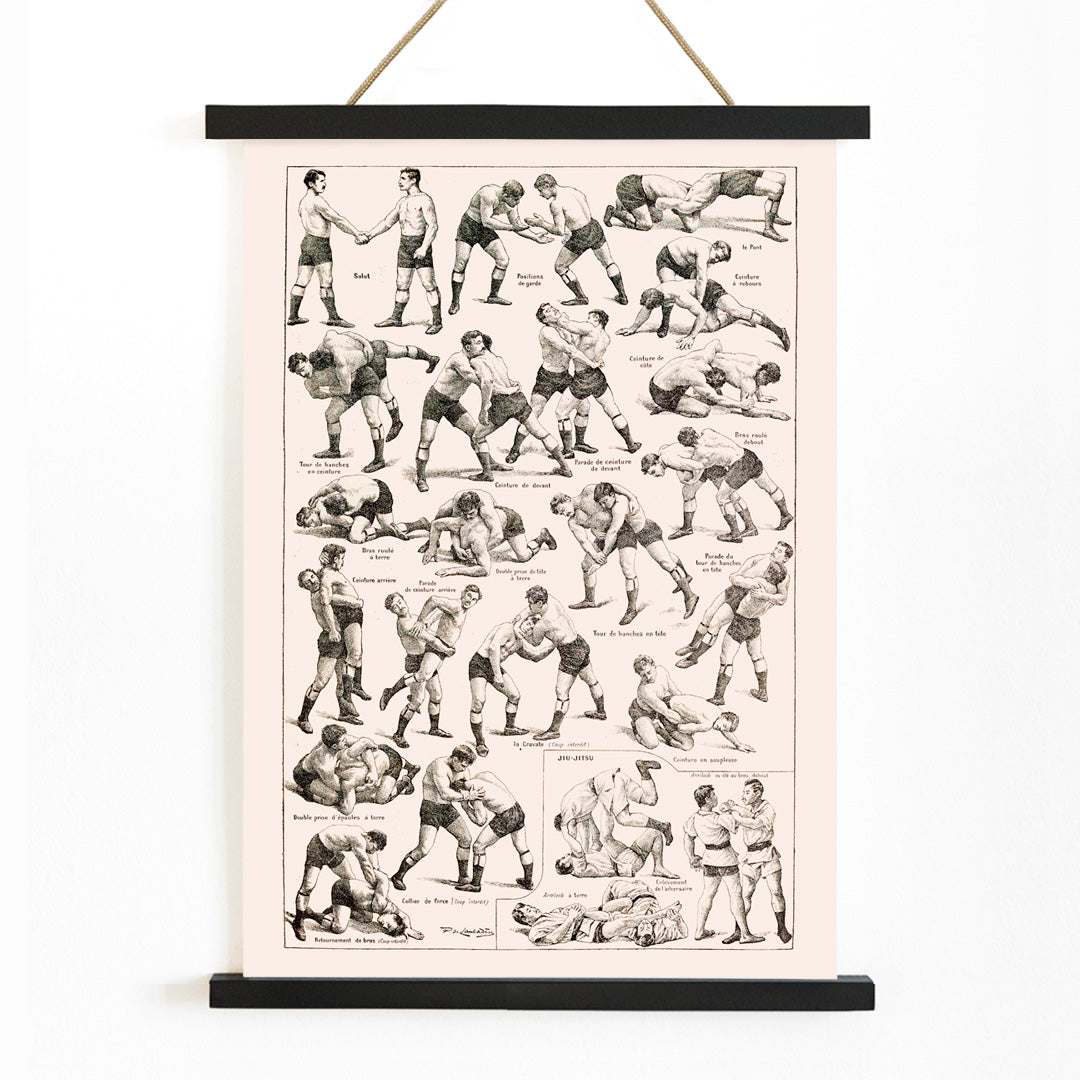
This 1908 Larousse wrestling plate, titled Lutte, was created at a time when physical education and organized sports were gaining prominence across Europe. The print served as an educational tool, introducing readers to the fundamentals of wrestling through a series of labeled diagrams. It embodies the era’s fascination with systematizing knowledge, turning athletic technique into a subject for study and self-improvement.
As a piece of popular educational material, this print captures the intersection of sport, pedagogy, and visual culture. It stands as a historical document of how physical practices were codified and disseminated, making it especially appealing to those interested in the history of sports and educational ephemera. For more on scientific illustration, explore our science collection or discover other striking examples in black and white wall art.
Style & Characteristics
The artwork features a series of small, clearly organized instructional scenes, each depicting specific wrestling holds and maneuvers. Figures are rendered in precise black linework with minimal shading, set against a warm, aged paper background. The layout prioritizes clarity and function, resembling textbook or manual illustrations from the early 1900s.
This restrained palette and analytical composition create an archival, almost typographic feel, where both the human form and accompanying labels are given equal visual weight. The overall effect is focused and methodical, appealing to admirers of vintage educational prints and those drawn to the understated authority of early 20th-century graphic design.
In Interior Design
This vintage print brings a sense of history and intellectual curiosity to interiors such as studies, libraries, creative studios, or even home gyms. Its neutral tones and structured layout pair well with minimalist, industrial, or classic decor, especially when complemented by oak, linen, or matte black frames from our frames collection.
Displayed alongside other educational or scientific prints, it can help create a gallery wall that celebrates knowledge, movement, and the visual language of discovery.