


You may also like
-
Human Blood System Poster
Institute of Liepzig · 1906 · Detailed anatomical poster mapping blood circulation with red and blue vessels on beige
Poster from €9 · Framed from €16
Regular price From €6,00Regular price -
Human Nervous System Poster
Galtier-Boissière and Émile · 1912 · Detailed anatomical scientific print of the human nervous system in red on white
Poster from €9 · Framed from €16
Regular price From €6,00Regular price -
Human Skeleton Poster
Institute of Liepzig · 1900 · Detailed human skeleton scientific print with crisp linework on warm beige paper
Poster from €9 · Framed from €16
Regular price From €6,00Regular price -
The human body Poster
Augé and Claude · 1900 · Antique anatomical scientific print presenting the human figure with labeled study diagrams
Poster from €9 · Framed from €16
Regular price From €6,00Regular price


-

"Very nice Posters. The quality is amazing and we received it very quickly !"
-

"A shop to visit absolutely. Huge selection of posters. We spent more than an hour there !"
-

"Perfect to find gift. Price are very good. An they can frame and pack it on site"


About the Artist
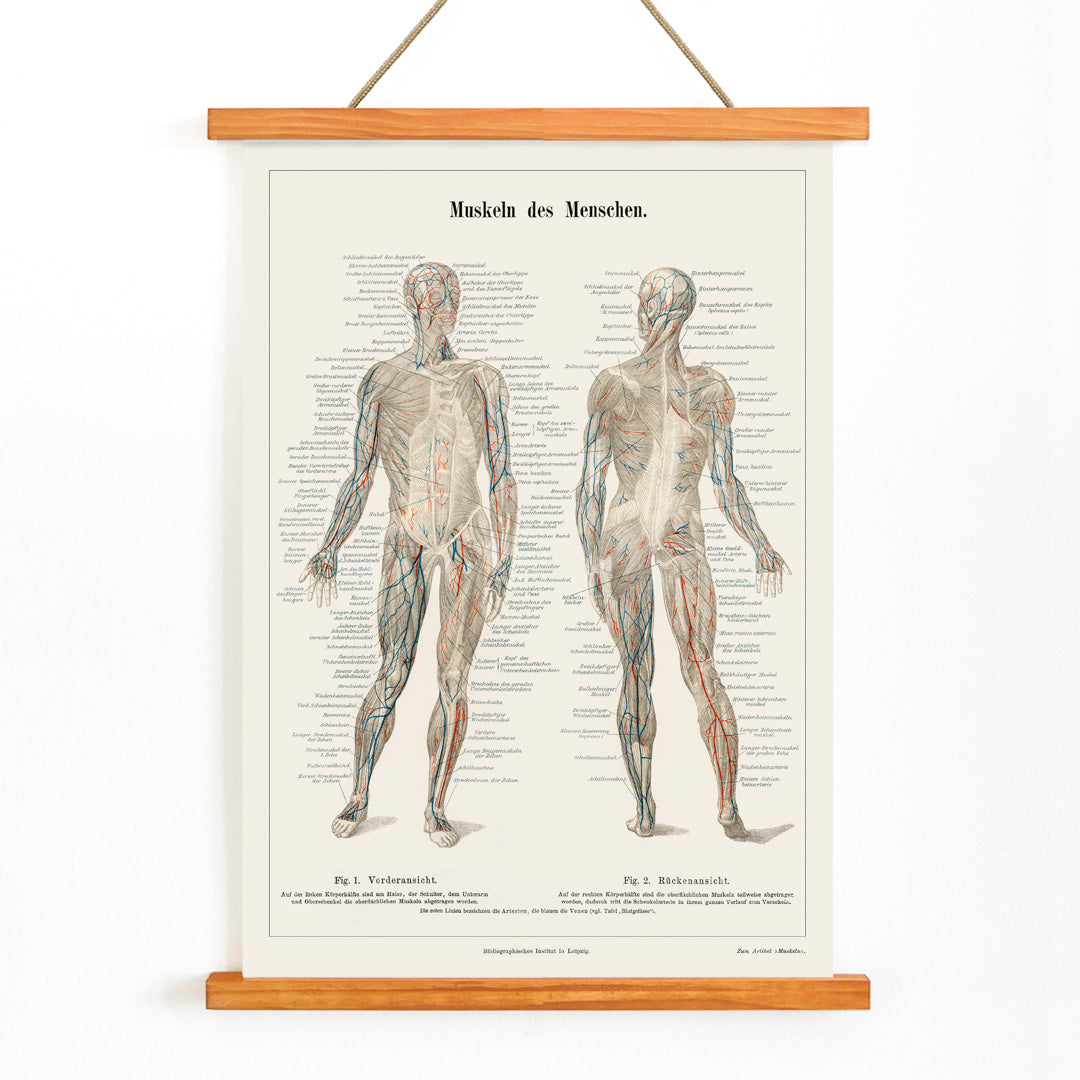
Created by an anonymous artist, this 1894 anatomical plate exemplifies the rigorous academic standards that shaped medical illustration in the late 19th century. Such works were produced for reference books and encyclopedias, serving as essential tools for doctors, students, and educators seeking clarity and accuracy in anatomical knowledge.
The artist’s objective was not personal expression but precise communication, resulting in images that balanced scientific utility with visual sophistication. Today, these plates are appreciated as both historical documents and striking wall art, bridging the worlds of science and design.
The Artwork
This human musculature plate emerged during a period when educational illustration was central to medical training. As anatomy became a standardized field, detailed charts like this one helped unify instruction and made complex information accessible to a broader audience. The plate reflects a time when the study of the human body was formalized through visual aids, supporting both professional and lay understanding.
Viewed now, it stands as a testament to the era’s dedication to knowledge and the enduring intrigue of anatomical illustration. Its presence in a modern space evokes both the history of science and the timeless fascination with the human form.
Style & Characteristics
The composition features a full-figure depiction of the muscular system, accompanied by smaller anatomical studies and dense labeling. Fine linework, crisp outlines, and subtle shading create a sense of depth and structure, characteristic of late 19th-century lithographic prints.
The artwork is set against a warm beige background, with black typography and anatomical markings. Red and blue accents highlight specific muscles and features, guiding the viewer’s eye. The overall mood is intellectual and slightly uncanny, making this a classic scientific print that emphasizes detail and clarity.
In Interior Design
This anatomical print lends a scholarly touch to home offices, libraries, hallways, or creative studios, inviting curiosity and conversation. It pairs well with dark wood, brushed metal, or minimalist white interiors for a curated, thoughtful atmosphere.
It fits seamlessly into science wall art displays and complements beige-toned prints for a calm, archival effect. For contrast, combine it with black and white posters to highlight its subtle color accents and vintage character.